
See the Selfdrive dashboard
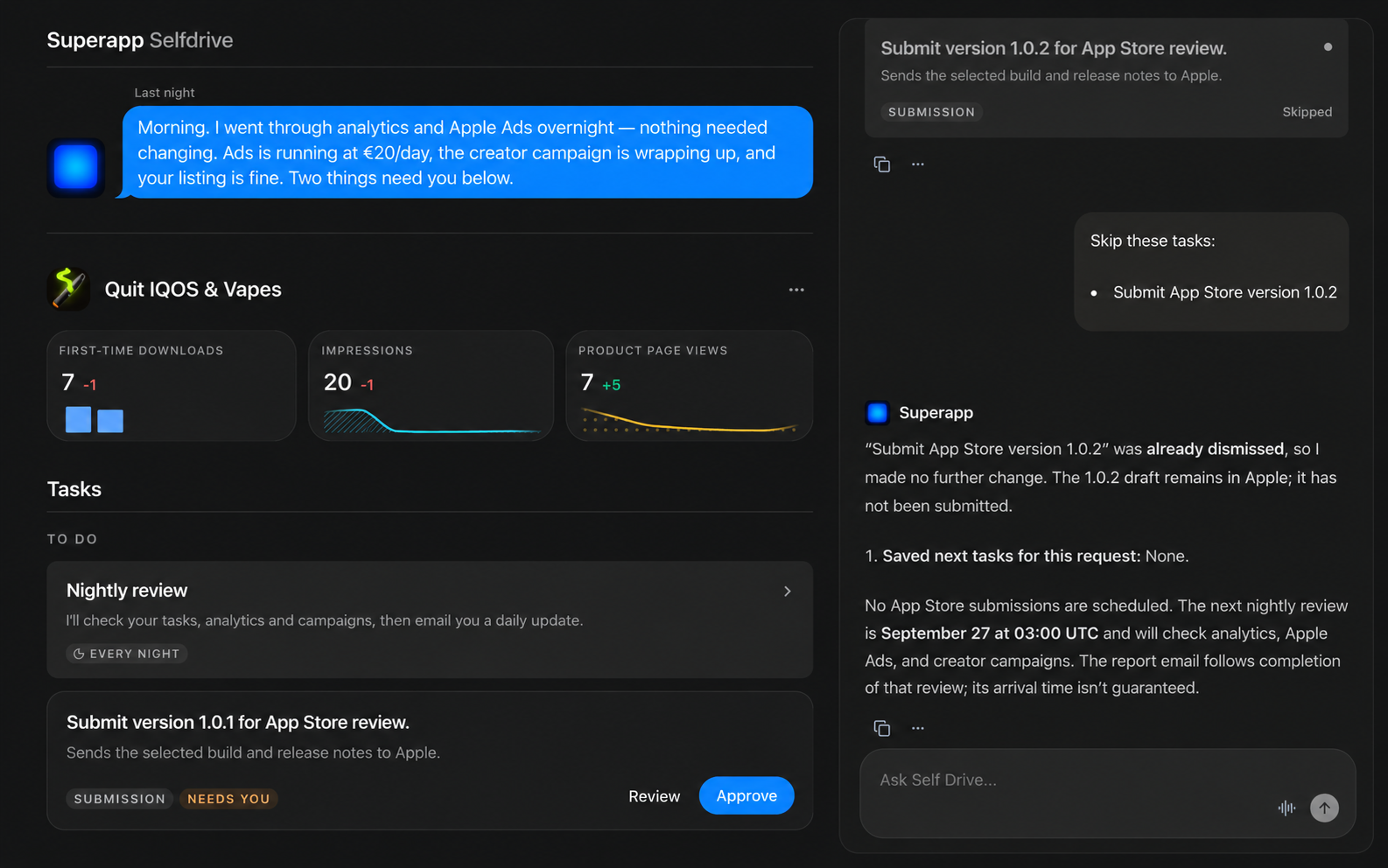
The same Selfdrive dashboard shown on our landing page: app analytics, pending tasks and the conversation with your agent.
Explore SelfdriveSEO for apps starts with the problem your app solves
Your app’s website should answer the questions prospective users already have. A workout app might explain a training problem; a budgeting app might help someone organize expenses. The article needs to be useful even before the reader downloads anything. The app then becomes a relevant next step rather than an unrelated advertisement.
Selfdrive starts with the app, its audience, and its existing positioning. Give the agent accurate information about released features and the markets you serve. Do not ask the content to promise features that are still ideas. That boundary helps keep search traffic aligned with people who can actually benefit from the product.
The automated SEO loop
The working loop is research, plan, write, publish, and report. Research finds questions connected to the app. Planning decides which questions deserve a page and how they relate to existing content. Writing produces a draft that should be checked for accuracy, usefulness, and a clear connection to the app.
Publishing follows the process agreed for the channel. A scheduled cadence is not a reason to post weak or repetitive articles. Reporting records what was prepared or published, what requires your attention, and what the next action should be. Evaluate the loop by useful work and qualified visits, not by the number of words generated.
What you approve before content goes live
You define the app’s positioning, the website’s purpose, and the publishing plan. Confirm whether individual articles need review and which changes the agent can make under that plan. A clear approval process is especially important when content mentions prices, health outcomes, financial topics, customer stories, or competitor comparisons.
Approval is an editorial responsibility. Check that screenshots match the current app, links lead to the correct destination, and factual claims have appropriate sources. If a draft includes a customer result, use it only when you can verify it and have permission to publish it. The agent cannot supply that permission on your behalf.
Generative engine optimization and AI search visibility
Selfdrive’s website workflow also researches AI answers and uses that context to shape app-focused content. Clear explanations, specific evidence, and direct answers help readers understand the product whether they arrive through Google, a recommendation, or an AI assistant. Keep the app’s capabilities consistent across the site and its store listing.
AI answer inclusion is not a placement you can buy from Selfdrive. Different prompts, models, and dates can produce different recommendations. Treat any citation as an observation, not a permanent ranking. The useful goal is to publish accurate material that answers the relevant question and gives a reader a reason to investigate the app.
Measure published work before promising results
Review the actual published URL and the question it answers before evaluating traffic. Then look at discovery, clicks, and the actions people take after arriving. An article with fewer visits but more relevant users can be more valuable than a broad article that attracts people who will never use your app.
Search performance takes time and depends on competition, indexing, site quality, and demand. Use consistent periods when comparing results. Record publication dates and other marketing changes so you do not attribute every increase to SEO. Selfdrive’s daily report helps you follow the work; it is not a guarantee of rankings or revenue.
How it works
Connect your app and website
Provide the App Store destination, audience, and accurate feature information. Connect the app website and domain through the supported workflow. Selfdrive can work with an existing app even when that app was built outside Superapp.
Approve a focused content plan
Choose the audience questions and publishing cadence. Agree how article approval works before scheduling publication. Keep the first plan narrow enough that you can review the quality and relevance of the work rather than approving an unbounded volume target.
Review and publish useful answers
Check drafts against the app’s actual functionality, add evidence, and verify links. Publish according to the agreed process. Each article should answer a distinct question and give readers a clear, relevant route to learn about the app.
Read the report and adjust
Review completed work and items waiting for approval. Look for evidence of useful discovery and customer interest over time. Change the plan when the topic attracts the wrong audience or the app’s features and positioning change.
Compare SEO delivery workflows
Compare the workflow and responsibilities, then check the linked providers for current plans and terms.
| Approach | Research and writing | Publishing responsibility | Cost basis |
|---|---|---|---|
| Selfdrive | Agent for app-focused content | Configured approval process | Max $100/month; credits apply |
| Freelance writer | Commissioned articles | Usually owner or editor | Quote per article or project |
| SEO agency | Contracted strategy and delivery | Defined in the engagement | Scope-based retainer or project |
| General writing assistant | Owner directs each request | Owner publishes and follows up | Provider subscription and owner time |
Pricing and running costs
Selfdrive is included in Superapp Max at $100 per month. Agent work uses credits; Apple Ads spend and creator fees are separate. Start with an approved budget and review the work before increasing it. A subscription is not an unlimited advertising or content-production budget.
Check current plans and credit allowances before starting. Estimate both the first release and ongoing operation: maintenance, provider usage, and customer support continue after launch. Start with a focused workflow so you can measure actual costs before expanding the product.
Limitations and your responsibilities
Selfdrive’s SEO workflow is for app websites, not an unrestricted technical SEO service for any existing site. Search engines and AI systems control discovery and recommendations. The owner supplies accurate product information, approves the publication process, and reviews claims. External analytics availability and attribution limit what can be concluded from reported changes.